Optimising the industry engagement funnel

I restructured the University of Sydneys industry engagement pages to make the engagement options easier to scan and to increase click-through rates.
Employer

University of Sydney

Employer

University of Sydney

Employer

University of Sydney

Role

Senior UX Designer

Role

Senior UX Designer

Role

Senior UX Designer

When

April 2025

When

April 2025

When

April 2025

Screenshot of user dashboard of spindle app

The brief

The brief

The brief

I was provided a very loose brief
"improve the industry section of the university site".

The University's industry section explains how industry can engage with the university across student programs, research collaboration, licensing opportunities, consultancy services, and more.
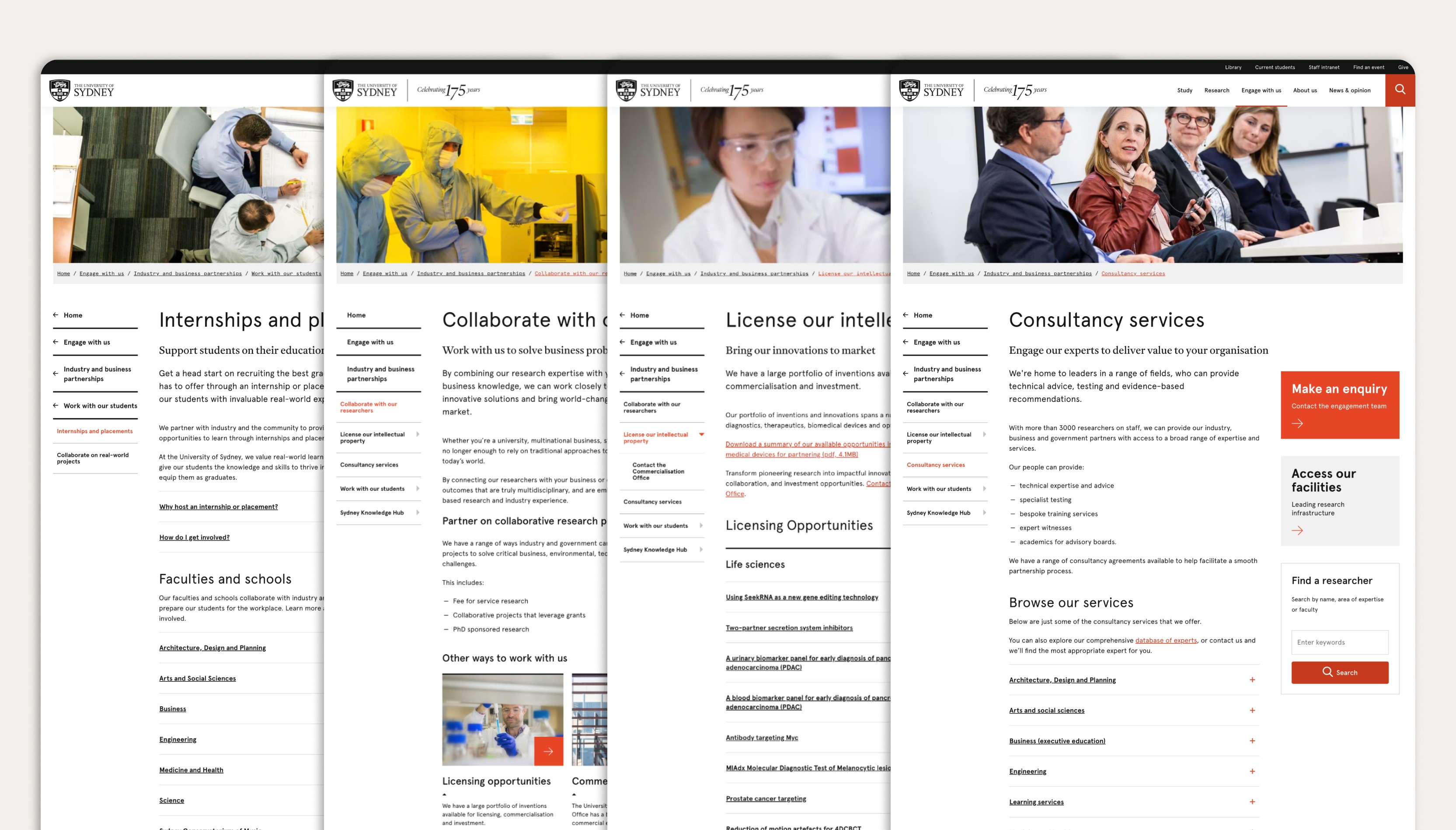
Screenshots of various pages within the Industry section of the website.
⛔️ I had some contrainsts

01

Built within existing CMS constraints

No dev capacity for custom components, so all improvements were delivered using the current CMS templates and component library.

01

Built within existing CMS constraints

No dev capacity for custom components, so all improvements were delivered using the current CMS templates and component library.

01

Built within existing CMS constraints

No dev capacity for custom components, so all improvements were delivered using the current CMS templates and component library.

02

Information architecture was out of scope

Navigation and IA changes (especially top-level structure) were intentionally avoided due to high organisational complexity and political risk, so the work focused on improving journeys within the existing section structure.

02

Information architecture was out of scope

Navigation and IA changes (especially top-level structure) were intentionally avoided due to high organisational complexity and political risk, so the work focused on improving journeys within the existing section structure.

02

Information architecture was out of scope

Navigation and IA changes (especially top-level structure) were intentionally avoided due to high organisational complexity and political risk, so the work focused on improving journeys within the existing section structure.

Discovery

Discovery

Discovery

I started by collecting more information to understand where problems may lie

How I gathered information

01

Content audit

Reviewed the section end-to-end to spot broken patterns, unclear page purpose, and where key pathways were getting buried.

01

Content audit

Reviewed the section end-to-end to spot broken patterns, unclear page purpose, and where key pathways were getting buried.

01

Content audit

Reviewed the section end-to-end to spot broken patterns, unclear page purpose, and where key pathways were getting buried.

02

Staff consultation

Mapped ownership and constraints, and sanity-checked what needed to stay vs what could change quickly.

02

Staff consultation

Mapped ownership and constraints, and sanity-checked what needed to stay vs what could change quickly.

02

Staff consultation

Mapped ownership and constraints, and sanity-checked what needed to stay vs what could change quickly.

03

User research

Validated what partners actually look for: clear starting points, the right contacts, and credible proof across engagement types.

03

User research

Validated what partners actually look for: clear starting points, the right contacts, and credible proof across engagement types.

03

User research

Validated what partners actually look for: clear starting points, the right contacts, and credible proof across engagement types.

04

Competitor analysis

Identified common page models and conversion patterns, then used them to shape scope and page structure.

04

Competitor analysis

Identified common page models and conversion patterns, then used them to shape scope and page structure.

04

Competitor analysis

Identified common page models and conversion patterns, then used them to shape scope and page structure.

What I learned

Decentralised ownership

A central engagement team exists, but most engagement happens in faculties, each with their own sites, standards, and content quality.

Decentralised ownership

A central engagement team exists, but most engagement happens in faculties, each with their own sites, standards, and content quality.

Decentralised ownership

A central engagement team exists, but most engagement happens in faculties, each with their own sites, standards, and content quality.

Confusing offerings

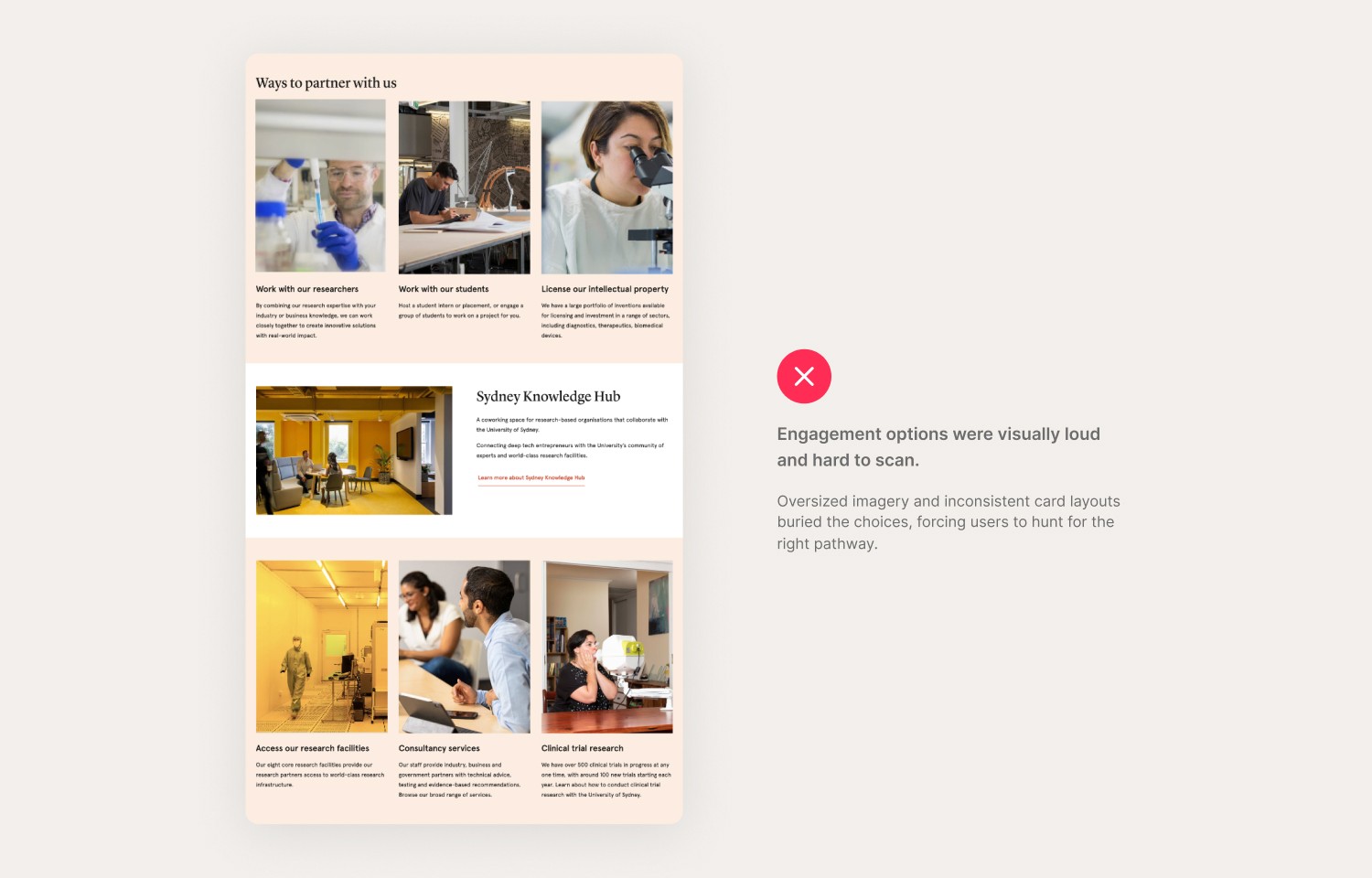
The offer wasn’t packaged clearly: “how to work with us” wasn’t obvious.

No clear starting point

Pages didn’t answer “where do I start?” and buried the next step.

Metric challenges

‘Conversion’ pages varied wildly (forms, emails, phone numbers, faculty landing pages), so measurement needed a pragmatic definition.

Low appetite for change

Key stakeholders were time-poor and resistant to edits, so the work needed to prioritise minimal, high-leverage improvements.

Poor web content and design

The pages lacked basic web patterns: inconsistent page types, weak hierarchy, and a lack of clear purpose.

Scoping a project

Scoping a project

Scoping a project

I then scoped out a clearer project brief

Once it was clear a lot of the issues were structural and slow to fix, I set a timebox (a few months) and focused on what we could improve quickly and measure reliably.

Objective

Improve performance of industry service pages.

I focused on removing noise and making the next step obvious, so more visitors progressed from high-level pages into real engagement opportunities.

KPI

CTR to next conversion point for any given page

Because conversion endpoints varied (and were often owned by faculties), we measured success by click-through to the closest actionable step.

Scope

"Central-owned" service pages incl. category pages

The industry landing page and the key category/service pages within the central section that we could update, publish, and measure. We will NOT attempt to fix the downstream faculty pages, forms, or processes.

Timeline

3 months

A short cycle to ship measurable improvements and leave a clear set of recommendations for anything bigger.

Design principles

Design principles

Design principles

I created a repeatable page recipe so we could scale improvements across the site section

I worked with another UX designer on this section. The recipe below made the work easier to distribute and helped keep decisions consistent across different page owners and approval constraints.

  • Make pages scannable

    Short sections, clear headings, and no walls of text.

  • Make pages scannable

    Short sections, clear headings, and no walls of text.

  • Make pages scannable

    Short sections, clear headings, and no walls of text.

  • Show choices early

    Surface the main engagement options up front (scan-first).

  • Show choices early

    Surface the main engagement options up front (scan-first).

  • Show choices early

    Surface the main engagement options up front (scan-first).

  • Reduce competing exits

    One primary CTA (typically “Get in touch”), with lower-priority links pushed down.

  • Reduce competing exits

    One primary CTA (typically “Get in touch”), with lower-priority links pushed down.

  • Reduce competing exits

    One primary CTA (typically “Get in touch”), with lower-priority links pushed down.

  • Consistent soft ask

    Stats and stories support decisions after options are clear.

  • Consistent soft ask

    Stats and stories support decisions after options are clear.

  • Consistent soft ask

    Stats and stories support decisions after options are clear.

Example 1

Example 1

Example 1

Industry section landing page

Page purpose

Introduce the overall offer and help industry quickly choose a pathway (category) to the right type of engagement.

Key changes

Options were buried behind long text and competing content (stats, links, accordions).

  • Made the 5 engagement pathways the hero (icon grid near the top).

  • Reduced to one primary CTA (“Get in touch”).

  • Moved proof (stats + stories) below the pathways.

  • Added a consistent “Not sure where to start?” banner as the fallback.

Result

+85% CTR to engagement categories i.e. “Ways to work with us”.

Screenshots
Slide 1
Previous
Next

Example 2

Example 2

Example 2

Research collaboration page

Page purpose

Help partners understand how research collaboration works and give them one clear way to start a conversation.

Key changes

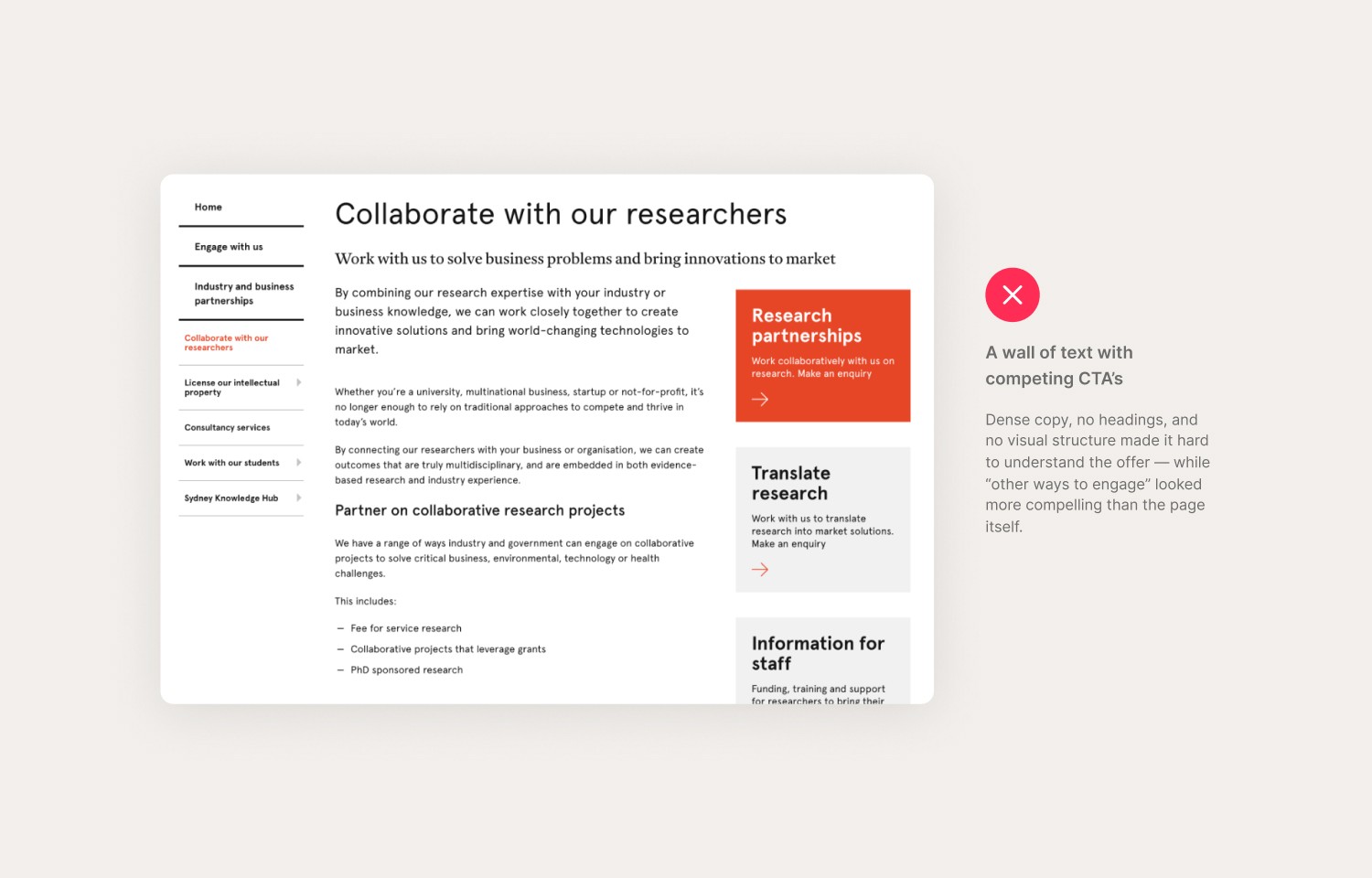
The original page used a 3-column layout with too many competing actions (right-rail CTAs, tools, funding links, repeated nav).

  • Rebuilt as a single-path landing page.

  • Added scannable sections with clear headings (no walls of text).

  • Promoted one primary CTA (“Get in touch”) near the top.

  • Kept success stories as supporting proof at the bottom.

  • Pushed low-priority links down into the banner area.

Result

+63% CTR to 'get in touch' call to action

Screenshots
Slide 1
Previous
Next

Example 3

Example 3

Example 3

Host a student intern page

Page purpose

Help employers understand the value of hosting an internship/placement and take a clear next step to set one up.

Key changes
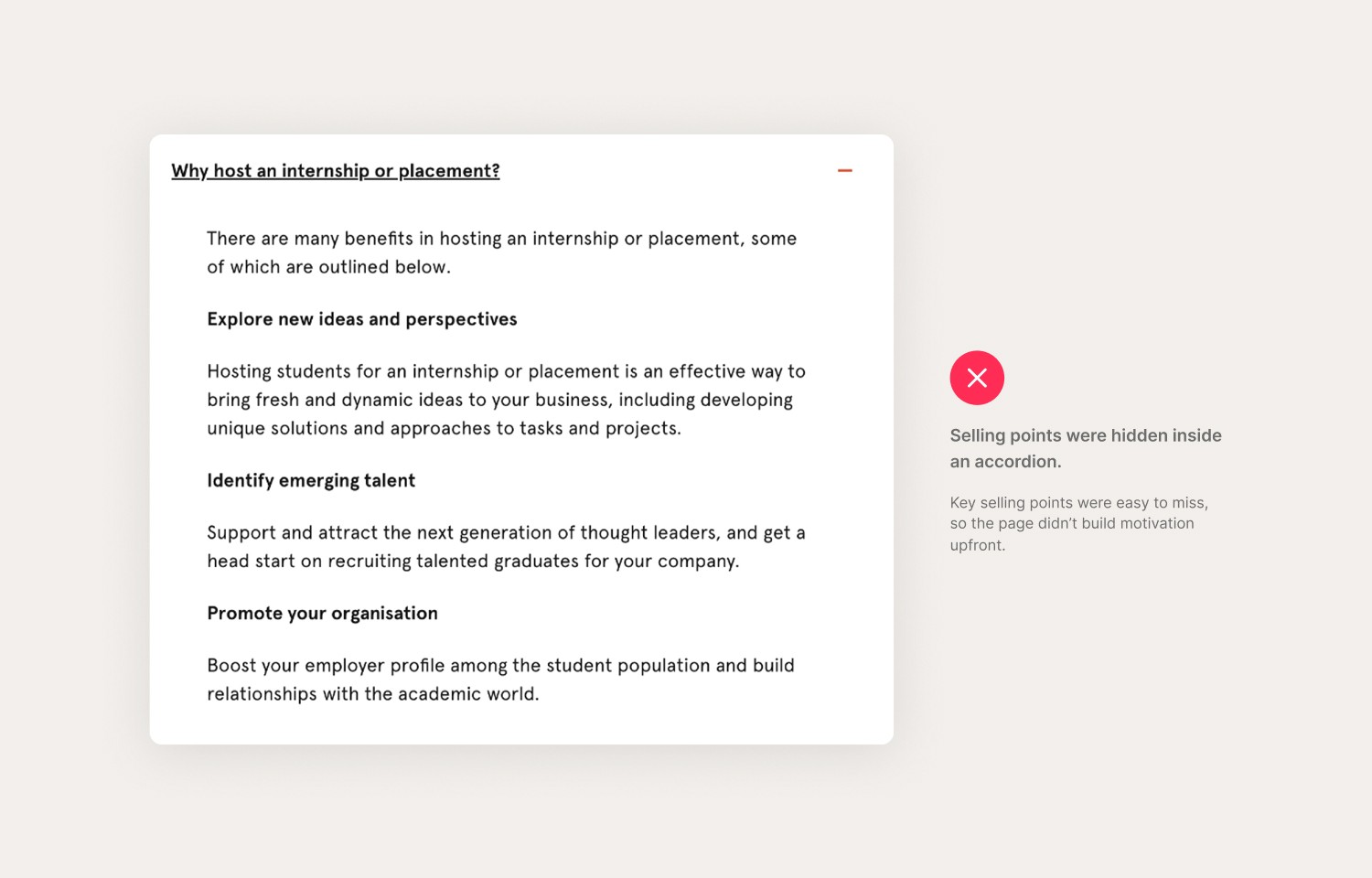
  • Pulled “why host an intern” benefits out of an accordion and turned them into scanable icon tiles near the top.

  • Removed redundant accordion interactions for “browse by faculty” and made faculty pathways easier to find and click.

  • Simplified “how to get involved” from mixed text links into a clearer, more deliberate pathway.

  • Reduced competing options (e.g. CareerHub/job ads) and centred one primary action: “Get in touch”.

  • Added a second soft CTA banner near the end of the page to catch users who need reassurance after scrolling.

Result

+22% CTR uplift to get in touch CTA.
Screenshots
Slide 1
Previous
Next

Reflections

Reflections

Reflections

Wins and learnings

More projects